WHY IN NEWS
With Assembly polls round the corner in Tamil Nadu, the Pongal festival and Jallikattu, the traditional bull-taming sport, have caught the attention of the political parties.
WHAT IS JALLIKATTU
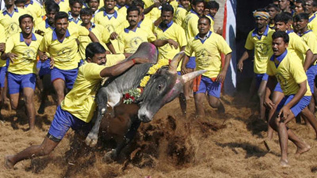
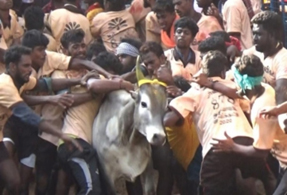
Jallikattu is a traditional bull-taming sport held in Tamil Nadu as a part of Pongal celebrations. It involves taming a bull with bare hands, that is set free inside an arena filled with young participants. Ideally, participants try to grab the bull by its horns or tail and wrestle it into submission. A few also tend to latch on to the bull by clinging to the hump at the back of its neck.
WHO OPPOSES IT AND WHY
Animal activists, the FIAPO (Federation of India Animal Protection Agencies) and PETA India have protested against the practice since 2004.The Animal Welfare Board of India filed a case in the Supreme Court for an outright ban on Jallikattu because of the cruelty to animals and threat to public safety. They also claim that Jallikattu is promoted as bull taming but actually it exploits the bull’s natural nervousness as prey animals by deliberately placing them in a terrifying situation in which they are forced to run away from those they perceive as predators and the practice effectively involves catching a terrified animal. It causes fatal injuries to both bulls and humans.
WHAT IS THE STAND OF THE SUPREME COURT AND GOVT OF INDIA
• In November 2010, the Supreme Court permitted the Government of Tamil Nadu to allow Jallikattu for five months in a year and directed the District Collectors to make sure that the animals that participate in Jallikattu are registered with the Animal Welfare Board and in return the Board would send its representative to monitor the event.
• Meanwhile, the Ministry of Environment and Forests, issued a notification in 2011 that banned the use of bulls as performing animals, thereby banning the event. But the practice continued to be held under Tamil Nadu Regulation of Jallikattu Act No 27 of 2009.
• In 2013, PETA reported that despite Supreme Court guidelines, the cruelty to bulls continues e.g. to ensure that the bull behaves aggressively, organizers injure its tail, put chilli powder in its eyes, or even feed desi liquor to the bull. When bull behaves violently, crowd gangs up and beats it mercilessly. PETA made a documentary, and asked SC for complete ban of this festival.
• In May 2014, the Supreme Court of India banned the practice, citing animal welfare issues. “The court drew upon Upanishadic wisdom and advised Parliament to “elevate rights of animals to that of constitutional rights… so as to protect their dignity and honour.
• On 7January 2016, the Ministry of Environment and Forests modified its order and permitted the continuation of the tradition under certain conditions, effectively ending the ban. It, however, added a few guidelines to regulate it: these events shall take place in these areas at such places as the district magistrate or collector explicitly permits, and that the bull once out of the enclosure shall be tamed within a radial distance of 15 metres etc.
• The ball reached the Supreme court again and after hearing the petitions led by the Animal Welfare Board of India challenging central government’s notification ,the Supreme Court of India on 12 January 2016 ordered a stay, issued notices to the central government and Tamil Nadu Government and later refused to lift the stay.
• On January 12, 2017 the court refused to be hurried into pronouncing its verdict before Pongal on a government notification of 2016 allowing jallikattu. So the ban continued.
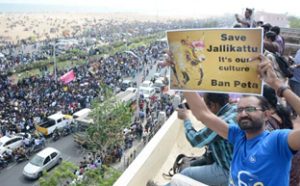
But the Tamil Nadu government vehemently argued in favour of the notification, saying that it had introduced stringent controls over the conduct of the sport. The Central govt., also argued against “absolute prohibitionism” in the case of jallikattu. But the court remained unmoved and unimpressed and did not allow jallikattu to take place that year. This led to protests all across the state of Tamil Nadu.
• Seeing the massive uprising all across the state, Tamil Nadu government urged the central govt to clear its proposal to promulgate an ordinance to allow jallikattu negating the Supreme Court order. On 20th Jan, centre cleared the proposal and the very next day TN govt promulgates an ordinance to conduct jallikattu with proper safeguards.
• Subsequently, at a special meeting, TN assembly passed the Prevention of Cruelty to Animals Act (Tamil Nadu amendment), 2017.The legislation seeks to amend certain sections of the central act to ensure that bulls are not barred from being used for the rural bull taming sport.
• PETA challenged the state move, arguing it was unconstitutional. In 2018, the Supreme Court referred the Jallikattu case to a Constitution Bench, where it is pending now.
WHY DID THE GOVT DECIDE TO OVERTURN THE JUDGMENT BY THE SUPREME COURT?
The pride in Tamil culture is central to Dravidian nationalism, which continues to shape the political discourse in Tamil Nadu. Therefore there has been a widespread opinion in the State in favour of the traditional sport. The move to overturn the Supreme court judgement is seen as an attempt by the government to appease the Tamil voters.
WHY PEOPLE OF TAMIL NADU RESIST THE BAN
Jallikattu is an ancient sport of Tamil Nadu having references in ancient Tamil literature from periods as old as the days of Tholkappiam, which is believed to have been written more than two thousand years ago. Therefore banning it would only dent the tamil culture.
Organisers of Jallikattu and bullock-cart races argue that these are traditional practices closely associated with the village life. This event is about showcasing the quality of cattle, the breeding skills of cattle rearers, the centrality of cattle in an agrarian economy, and the power and pride they bring to farmers and land-owning castes in rural Tamil Nadu. For agrarian communities like Thevars and Maravars, Jallikattu is one of the few markers of their social standing and identity in a fast-changing world. As far as ,cruelty to animals is concerned ,Jallikattu bulls are specifically identified, trained and nourished for these events and that owners spend considerable amount money for their upkeep.
Jallikattu’s linkages with Pongal has lifted it above its regional and community origins and transformed it into a symbol of Tamil culture and pride. Rural communities ,therefore ,see judicial attempts to ban them as an assault on their tradition and cultural rights. They argue that these events should be regulated, but should not be completely prohibited.
VIEWPOINT- Regulation OR Outright ban?
• BAN The march of civilisation has led to the abandoning/banning of many inhuman and regressive practices like Sati, child marriage and untouchability, which were once considered essential cultural practices, inextricable from tradition. Popular support for a cultural practice, or any cause, does not prove its “rightness”. In the case of Jallikattu, danger to life and limb of animals and humans is very real. On 22 January 2017,two people were killed and over 120 injured in the jallikattu at Pudukottai. A culture that legitimises such mindless and unnecessary death is not Tamil culture. In fact, it is no culture at all. Therefore it should be completely banned. “Regulation” of Jallikattu has been tried earlier and has failed miserably. There was a specific law brought in earlier for this purpose, called the State of Tamil Nadu Regulation of Jallikattu Act 2009. For 5 years from 2009 to 2014, the court did try to regulate the sport, but it didn’t worked and reports showed blatant cruelty, the court was left with no option but to ban the sport in its entirety. Moreover bowing down to unjustified demands of people would have a domino effect, with other states jumping into the fray and demanding that their banned traditional sports also be legalised. These include bulbul fighting in Assam and cock fighting in Andhra Pradesh.
• REGULATION– While it is true that tradition and culture are not immune to change but at the same time bans may not be the best way to bring in reforms in the society. Over the years, debates on the ethics of the use of animals, not just in sport but also in other fields of entertainment like the circus, have helped in sensitising society to animal rights to a great extent. But the change in mindset can only be achieved through education and negotiation. Blunt instruments like bans would only polarise the debate and may eventually cause a breakdown of the law and order. Also, a top-down approach that does not recognise communitarian sentiments is only likely to harden the conservative position and make reforms near impossible. The regulation of the sport, rather than an outright ban, may be a better way ahead. The sport should only be reintroducted after imposing the strictest regulations.
REFERENCE
- INDIAN EXPRESS
- THE TRIBUNE
- Images used are for representational purpose only.